
Twelve chips. Three rings on the ground. No launch monitor, no swing video, no scorecard. It looks almost too simple to tell you anything about a golfer.
It tells you a lot. Across 2,408 golfers assessed with the Player Development Index (PDI), this one short-game challenge lined players up by skill level almost perfectly, from beginners to Division I college players and touring professionals. It also tracked scoring average as closely as any part of the assessment, and more closely than the driver and full-swing challenges.
The reason is simple. Controlling how far the ball carries, from the moment the clubhead meets it to the spot where it first touches the ground, is one of the purest measures of skill in the game.
Three rings, twelve shots
The PDI is an assessment that measures a golfer as a whole athlete: golf skills, physical ability and mental game, combined into one score. Its chipping challenge is one of the quickest parts of it. Three rings are laid on the green at increasing distances from where the player stands:

The player hits four chips to each ring, 12 shots in all. A shot counts when the ball lands inside the ring. The score is simply how many of the 12 land where they were supposed to.
That’s it. Where the ball rolls after it lands doesn’t matter. The challenge isolates one thing: whether a player can send the ball a chosen distance through the air, again and again.
What each level averages
Line golfers up by skill level and the chipping score rises almost step for step.
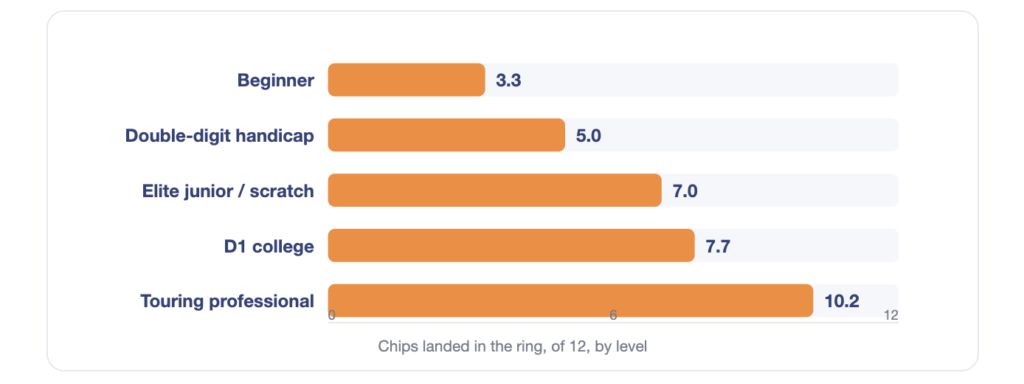
A beginner lands about 3 of 12. A double-digit handicap lands about 5. Elite juniors and scratch amateurs land about 7, D1 college players nearly 8, and touring professionals about 10.
The shortest ring tells the story most clearly. From 3 yards, beginners land about one chip in three. D1 players land three of every four, and touring pros land about nine in ten. It’s the shortest shot in the challenge, and it’s where the difference between levels is widest.
Why something this simple works
The real test of any assessment is whether it lines up with what happens on the course. So we grouped players by how many of their 12 chips landed in the ring and looked at their scoring averages.

Players who land 3 or fewer average about 93. Players who land 10 or more average about 76, roughly 17 strokes better. Of all the parts of the PDI golf assessment, the chipping score lined up with scoring average as closely as any, slightly more than putting and more than the full-swing challenges.
Why? Because a chip strips the game down to its core. There’s no power to hide behind and no long putt to save you. To land the ball in a ring, a player has to read the distance, choose a swing, and deliver the clubhead with just the right speed and contact so the ball carries the right amount. That’s feel, control and repeatability in one shot. It’s the same skill that saves pars from just off the green, and it’s built into every iron and wedge a player hits.
Where do you stand?
We grouped every player by how many of their 12 chips landed in the ring, regardless of their level, then looked at the average 18-hole score of each group and which kinds of players make it up.
The average D1 college player lands just under 8 of 12. Touring professionals average about 10, and every touring pro we’ve assessed landed at least 9. Even at the highest level, a perfect 12 is rare, which is exactly what makes it a good measuring stick.
Simple to set up, hard to fake
You can try a version of this on any practice green: three targets at 3, 10 and 20 yards, four balls to each, count what lands inside. It takes about ten minutes.
A full PDI assessment puts that number next to your putting, full swing, physical and mental results, then compares you with players at your level and the level you’re aiming for. That’s what turns 12 chips into a plan.
It may look too simple to matter. But the ability to control exactly how far the ball carries, shot after shot, is a skill every good player has and every developing player is still building. Twelve chips show you where you are on that path.
About the Study
2,408 golfers assessed with the PDI, each counted once using their most recent assessment. Scoring averages are the players’ reported 18-hole averages. The touring professional group is six players who play or have played professionally on tour, each averaged across their own PDI assessments (short-form and full PDI, which use the same 3, 10 and 20 yard rings). Touring pro and some college division averages are based on small numbers and should be read as directional. The data shows a link between chipping score and playing level, not proof that one causes the other.