Golfers who move well successfully execute 38% more of the shots they’re asked to hit. That’s what we found when we compared mobility scores with ball-flight control across 2,408 players.
Picture two golfers on the range. Same handicap, same clubs, same coach. Ask them to hit a high draw, then a low fade, then a straight shot, and one does it while the other keeps hitting the same shot. Most people would call that “ability” or “talent.” Our data suggests there could be an underlying factor at work: how well the body can move.
What the PDI measures
The Player Development Index (PDI) measures a golfer’s skills as a whole athlete. Looking closer at a few tests from the PDI assessment: One piece of the assessment covers how the body moves, how strong and powerful it is, and how well the player hits the shots the game demands. Each player gets one score and a clear picture of what to work on next.
This study uses three test from the PDI assessment:
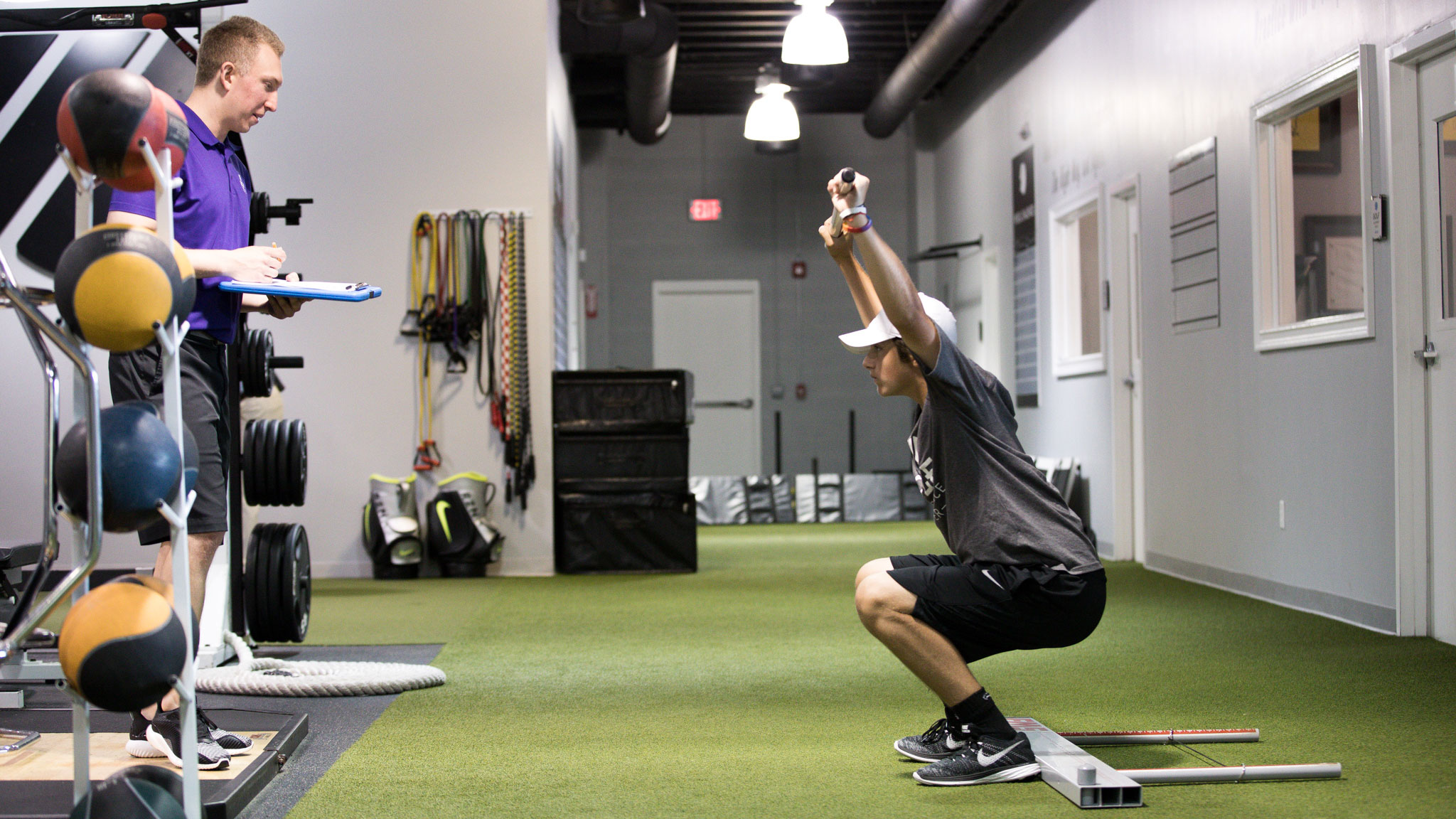
- Deep Squat. The player holds a club overhead with straight arms and squats as low as they can. It shows whether the ankles, hips, upper back and shoulders all move freely together, which is the same chain a golf swing uses – a great snapshot view of full body mobility.
- Active Straight Leg Raise (ASLR). The player lies on their back and lifts one straight leg as high as possible while the other leg stays flat. Each side is tested. The ASLR assesses the ability to maintain pelvic and trunk stability while demonstrating active lower-extremity mobility and separation.
- 9 Ball Flights. With a 6-iron, the player tries to hit nine different shots: high, middle and low, each as a draw, straight and a fade. The score is out of 9. It’s the clearest test of ball striking control in the PDI.
Both movement tests are scored from 1 to 3. A 3 means the movement is done cleanly. A 1 means the player can’t complete the pattern without significant compensation, for example heels lifting in the squat or the leg barely rising in the straight leg raise.
What the data shows
We split players into three groups by their movement scores: those who scored 1 on all three tests, those who scored 3 on all three, and everyone in between. Then we compared how many of the nine shots each group could hit.
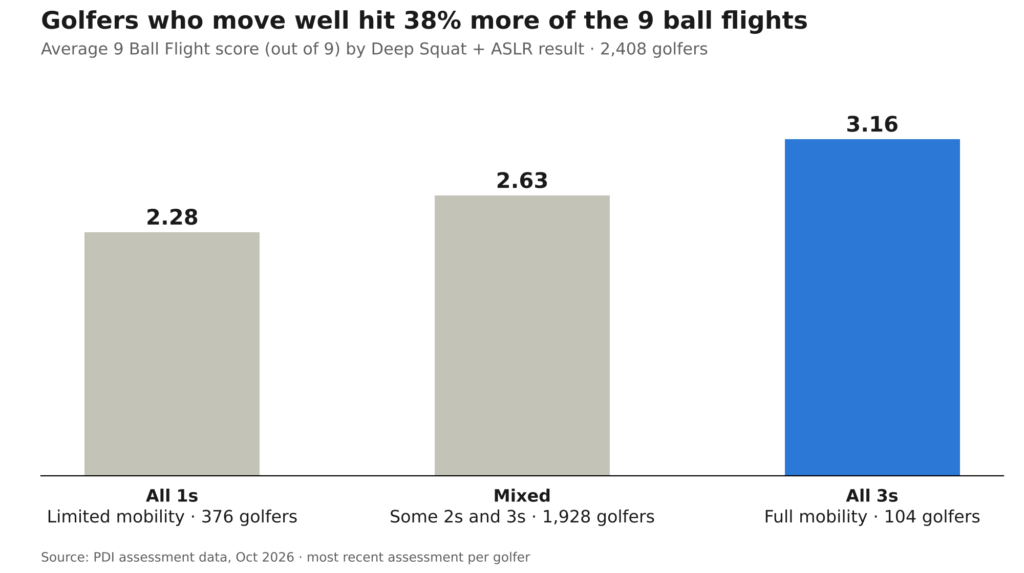
The fully mobile group hit almost one more shot shape out of nine. On a test where most golfers land between 2 and 3, that’s a large jump. Scores also rose step by step: the more freely a player moved, the more shots they could hit.
It isn’t just that better players move better
A fair question: maybe skilled golfers simply move better, and skill is what drives ball control. So we compared players within the same level. The mobility gap held for juniors, college players and adult amateurs alike.
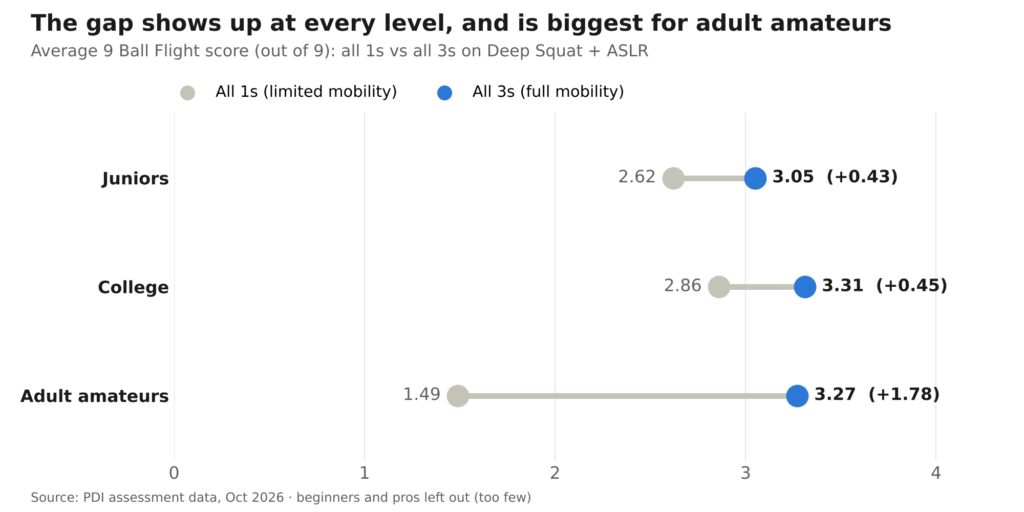
Adult amateurs show the biggest difference. Those who moved well hit more than twice as many shot shapes as those who didn’t, landing at the same level as college players. For many weekend golfers, the limit on shaping shots may be their hips and ankles, not their swing.
Why movement shows up in ball flight
Shaping a shot means changing the club’s path and face angle on purpose. A higher shot needs the body to stay back and turn through; a lower one needs the hands ahead and the chest covering the ball. Each shape asks the body to get into a slightly different position at impact.
A player with tight hips or ankles has fewer positions available. Their body finds one way to swing that works, and it repeats that swing whether they want a draw or a fade. The Deep Squat had the clearer link of the two tests on its own: average scores rose from 2.48 at a score of 1 to 2.89 at a score of 3. ASLR on its own moved less, but the biggest gap came when both tests were good.
In other words, a golfer can struggle to change the movement required to change a shot shape or trajectory, if range of motion is limited.
What to do with this
If you struggle to execute a certain ball flight, the fix may start off the range. Three steps:
- Find out where you stand. A PDI assessment scores your Deep Squat, ASLR and 9 Ball Flights side by side, so you can see whether movement is holding back your ball control.
- Work on mobility first. Ankle, hips, spine, shoulders are all mobile segments of the body that all play a critical role in how one moves. Improving the quality of movement only takes a few minutes a day, which can be done through the PDI app or a physical professional. It also lowers injury risk before you add strength or speed.
- Retest and track it. Measure again after a block of work and see whether your movement scores and ball flights rise together.
Golf has always rewarded players who can work the ball. This data suggests that skill is built in the body as much as on the range.
About the study: 2,408 golfers assessed with the PDI, each counted once using their most recent assessment. Players who scored 1 on all three movement tests (Deep Squat, ASLR left and right) were compared with players who scored 3 on all three. The data shows a link between mobility and ball-flight control, not proof that one causes the other.